


Guitars - Acoustic - Electric - Custom | Keyboards - Acoustic - Digital | Drums | Cymbals | Recording / Studio | Microphones | Amplifiers | Affiliates
Legendary Instruments
Hammond B3 - Flying V - Les Paul - Leslie - Moog - Stratocaster - Telecaster - White Falcon - Wurlitzer


Gretsch White Falcon
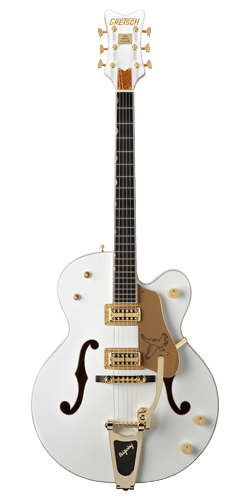
The Gretsch White Falcon guitar has a very unique, distinct appearance and was commercially introduced in 1955 by Gretsch. While it has had many substantial changes to its body shape and features through the years, being currently offered in several styles, the White Falcon has always maintained a striking and unmistakable presence and has become a highly recognized piece of Rock history.
The White Falcon is best known for its large size, (17" in width"), and distinctive appearance, with bright white paint, gold trim, and soaring falcon engraved on the gold pickguard. The Falcon was the brainchild of Gretsch marketing strategist Jimmie Webster, who in 1954 sought to design a "Dream Guitar", and gained his inspiration by walking through the Gretsch factory and watching the construction of the staggering diversity of musical instruments the company produced. From the banjo production line, Webster recalled the engraved pearl inlays that adorned the fretboard and headstock. Many of Gretsch's drums were covered with thick sparkly gold plastic that could also be used as binding on guitars. The combination of these eye-catching features with an immense 17" wide by 2-3/4" deep white body and highest quality gold-plated hardware rendered "the Cadillac of guitars," the White Falcon.
The White Falcon was unveiled at the NAMM show in July 1954 being displayed as "the guitar of the future," but Gretsch initially had no plans to actually manufacture the model. It was supposed to be a showpiece, but the sheer volume of questions received about the eye-catching instrument led to a reevaluation of this position, and the White Falcon hit stores in 1955 at the cost of $600, (over $4000 by todays standards).
So popular was the White Falcon, and the other Gretsch models of the time, that this era is frequently referred to as "The Golden Years" or "The Great Years" in Gretsch History. Through the '60s, Webster continually improved on the Falcon with more features, including a Stereo version and the late '60s, the Falcon was covered with controls and knobs. It has also switched to a twin-cutaway body beginning in 1962.
The new era of rock guitarist such as Jimi Hendrix, Jeff Beck, Eric Clapton and other musical greats were turning to Fender, rather than Gretsch, and bringing the burgeoning flock of wannabes along with them and the Gretsch Golden Years soon began it's decline. and after a decade of accomplishment, Fred Gretsch retired in 1967 and sold his company to Baldwin Manufacturing. Baldwin would have trouble understanding guitars in general and to make matters worse, the rapidly deteriorating Baldwin Manufacturing experienced two destructive fires at its new Arkansas plant in 1973. Gretsch limped through the '70s and finally stopped being produced in the '80s. being relegated to the domain of "collectibles". In 1989, Fred Gretsch III resumed control of the family business and began making guitars again. These instruments are based on classic Gretsch designs, including the venerable White Falcon.
From its introduction in 1954 through today, the White Falcon has always been known for its white finish, ebony fingerboard, 17" wide hollow body, gold-plated hardware, engraved gold pickguard, and gold sparkle binding. Throughout its history, some features have changed as technology and style evolved.
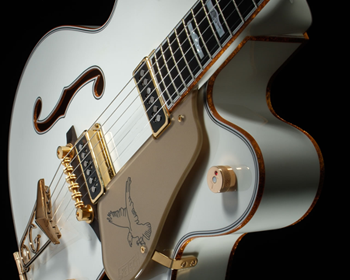 1954-1958, model number 6136: Vertical gold headstock logo with winged "G;" pearl block fretboard inlays with avian-themed engravings; two DynaSonic single coil pickups; control configuration consisting of master tone, master volume, volume for each pickup, and three-way toggle pickup selector switch; trapeze tailpiece with "G" and Cadillac-inspired "V"-shape; Melita bridge; 2-3/4" deep single-cutaway body.
1958-1962, model number 6136: Horizontal "T-roof" headstock logo sans wings; "Neo-classic" thumbprint fretboard inlays; two FilterTron humbucking pickups; control configuration consisting of master volume, volume for each pickup, three-way toggle pickup selector switch, and three-way toggle tone switch; Space Control bridge. A stereo model (6137) was introduced; this model featured an extra set of pickup selector and tone switches and had the bridge pickup moved closer to the neck.
1962-1964, model numbers 6136 and 6137 (stereo): Two-inch deep double-cutaway body with dual string mutes; standby switch; zero fret; white leather pad on the back.
1964-1972, model number 6136 and 6137 (stereo): Bigsby vibrato with telescoping "dog leg" arm; "T-zone tempered treble" slanted upper frets. 1973, model numbers 6136 and 6137 (stereo): Bigsby tailpiece with "V" cutout, reminiscent of the original "Cadillac" tailpiece. This is the last model year for "vintage" White Falcons.
1974-1981, model numbers 7593 (single-cutaway) and 7595 (double-cutaway): Angularly-shaped pickguard without "Gretsch"; rectangular block fretboard inlays; Baldwin "B" trapeze tailpiece; truss rod cover, string mutes and standby switch removed. In 1981, Gretsch ceased manufacturing guitars.
1995-present, model numbers 6136 and 7593: Models are now available commemorating every phase in the design of the White Falcon. Features are reproduced accordingly. Modern Falcons are also available in black and silver, and include a Stephen Stills signature model (based on the 1958 incarnation), as well as a green Bono Irish Falcon that incorporates the original vertical headstock logo and engraved block inlays with the post-1958 electronics configuration and features "The Goal Is Soul" silkscreened onto the pickguard. Gretsch recently added a Brian Setzer Black Phoenix model to its lineup. Like Brian Setzer's signature Hot Rod 6120, the Black Phoenix features stripped-down electronics that consist of two pickups, a selector switch, and a volume knob.
Legendary Suggestions? Send them Here
Aces and Eighths. A music resource site. Link To Us
Site Map  Comments or Questions
  Submissions
Privacy Policy
| Share |
               |

AcesandEighths.com - All Respective Copyrights © Apply
All text is available under the terms of the GNU Free Documentation License. (See Copyrights for details.)
Also under the Creative Commons Org License.