


Guitars - Acoustic - Electric - Custom | Keyboards - Acoustic - Digital | Drums | Cymbals | Recording / Studio | Microphones | Amplifiers | Affiliates
Legendary Instruments
Hammond B3 - Flying V - Les Paul - Leslie - Moog - Stratocaster - Telecaster - White Falcon - Wurlitzer


Moog Synthesizer
Moog synthesizer may refer to any number of analog synthesizers designed by Dr. Robert Moog or manufactured by Moog Music, and is commonly used as a generic term for analog and digital music synthesizers.
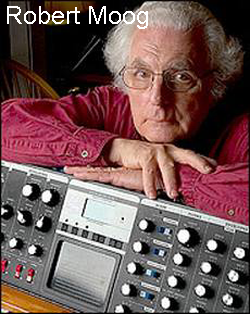
The Moog company pioneered the commercial manufacture of modular voltage-controlled analog synthesizer systems. Company founder Robert Arthur Moog had begun manufacturing and selling vacuum-tube theremins in kit form while he was a student in the early 1950s and marketed his first transistorized theremin kits in 1961. Moog became interested in the design and construction of complex electronic music systems in the early 1960s and the burgeoning interest in his designs enabled him to establish a small company (R. A. Moog Co., which later became Moog Music) to manufacture and market the new devices.
 Moog began to develop his synthesizer systems after he met educator and composer Herbert Deutsch at a conference in late 1963. Over the next year, with encouragement from Myron Hoffman of the University of Toronto, Moog and Deutsch developed the first modular voltage-controlled subtractive synthesizer modules. Through Hoffman, Moog was invited to demonstrate these prototype devices at the Audio Engineering Society convention in October 1964, where composer Alwin Nikolais saw them and immediately placed an order.
Moog's innovations were set out in his 1964 paper Voltage-Controlled Electronic Music Modules, presented at the AES conference in October 1964, where he also demonstrated his prototype synthesizer modules. There were two key features in Moog's new system: he analyzed and systematized the production of electronically-generated sounds, breaking down the process into a number of basic functional "blocks", which could be carried out by standardized modules, and he proposed the use of a standardized scale of voltages for the electrical signals that controlled the various functions of these modules -- the Moog keyboard, for example, used a standard progression of 1 volt per octave for pitch control.
Using this approach, Moog built a range of signal-generating, signal-modifying and controller modules, each of which could be easily inter-connected to control or modify the functions and outputs of any other. The central component was the Voltage-controlled oscillator (VCO), which generated the primary sound signal, capable of producing a variety of waveforms including saw-tooth, square and sine waves. The output from the VCO could then be modified and shaped by feeding the signal into other modules such as Voltage-controlled amplifiers (VCA), Voltage-controlled filters (VCF), envelope generators, ring modulators and other devices. The inputs and outputs of any module could be cross-linked with ¼-inch patch cords and, together with the module control knobs and switches, could create a nearly infinite variety of sounds and effects.
The final output could be controlled by an organ-style keyboard as the primary user interface, but the signal could also be triggered and/or modulated by a ribbon controller or by other modules such as white noise generators or low-frequency oscillators. The Moog modular systems were not designed as a performance instrument, but rather a sophisticated, studio-based professional audio system which could be used as a musical instrument for creating and recording electronic music in the studio.
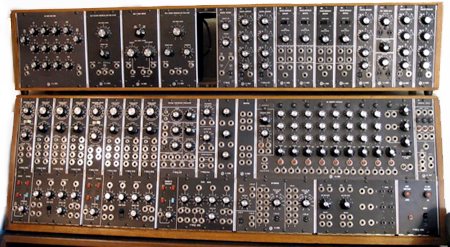 Moog's first customized modular systems were built during 1965 and demonstrated at a summer workshop at Moog's Trumansburg, NY, factory in August 1965, culminating with an afternoon concert of electronic music and musique concrete on August 28.
Although far more compact than previous valve-based systems (e.g. the RCA Mark II) the Moog modular systems were quite large by modern standards, since they predated the introduction of microchip technology; one the biggest of these, the Moog-based "TONTO" system (built by Malcolm Cecil and used by Stevie Wonder in the 1970s) occupies several cubic meters when fully assembled. These early Moogs were also complex to operate, sometimes taking hours to set up the machine for a new sound, - and they were prone to pitch instability because the oscillators tended to drift out of tune as the device heated up. As a result, ownership and use was at first mainly limited to clients such as educational institutions and major recording studios and a handful of adventurous audio professionals.
The Moog synthesizer began to gain wider attention in the music industry after it was demonstrated at the epochal Monterey International Pop Festival in June 1967. Electronic music pioneers Paul Beaver and Bernie Krause had bought one of Moog's first synthesizers in 1966 and had spent a fruitless year trying to interest Hollywood studios in its use for movie soundtracks. In June 1967 they set up a booth at the Monterey festival to demonstrate the Moog, and it attracted the interest of several of the major acts who attended, including The Byrds and Simon & Garfunkel. This quickly built into a steady stream of studio session work in Los Angeles and a recording contract with Warner Brothers.
At this early stage the Moog synthesizer was still widely perceived as a novel form of electronic keyboard, not unlike the Mellotron, which had appeared a few years earlier. Most early Moog appearances on popular recordings tended to make limited use of the synthesizer, exploiting the new device for its novel sonic qualities, and it was generally only used to augment or 'color' standard rock arrangements, rather than as an alternative to them -- as for example in its use by Simon and Garfunkel on their 1968 LP Bookends and The Beatles' final studio album Abbey Road.
According to the American Physical Society, "The first live performance of a music synthesizer was made by pianist Paul Bley at Lincoln Center in New York City on December 26, 1969. Bley developed a proprietary interface that allowed real-time performance on the music synthesizer." However, according biographical notes on the Hofstra University web site, Herbert Deutsch gave a concert at the New York Town Hall in September 1965 with his New York Improvisation Quartet which included the first live performance with a Moog synthesizer.
The first pop-rock recordings to feature the Moog synthesizer were Strange Days by The Doors, released in September 1967, followed by Pisces, Aquarius, Capricorn, & Jones, Ltd. by The Monkees and Cosmic Sounds by The Zodiac, both released in November 1967, The Notorious Byrd Brothers by The Byrds (January 1968) and Simon & Garfunkel's Bookends (April 1968). Buck Owens made the second purchase of the Moog, although no known music was developed by him on it. (Carlos purchased the first and Micky Dolenz of the Monkees purchased the third model).
 The crucial commercial breakthrough was made by New York-based recording engineer, musician and composer Wendy Carlos who, with producer and collaborator Rachel Elkind, was primarily responsible for introducing the Moog synthesizer to the general public and demonstrating its extraordinary musical possibilities. Carlos worked closely with Moog during 1967-68, suggesting many improvements and refinements to his modules, and during 1967 Carlos composed, realized and produced electronic sounds and music for a demonstration record for the Moog company. After assembling a Moog system and a custom-built 8-track recorder in early 1968, Carlos and collaborator Rachel Elkind (secretary to CBS Records president Goddard Lieberson) began recording pieces by Bach which were entirely realized on the new Moog. When Moog played one of their pieces at the AES convention in 1968 it received a standing ovation. The resulting album was released by CBS Records in late 1968 under the title Switched-On Bach. It quickly captured the public imagination, becoming one of the highest-selling classical music recordings ever released up to that time and earning Carlos three Grammy awards. The success of Switched-On Bach led to three more successful albums of electronically realized Baroque music by Carlos, as well as the acclaimed electronic soundtrack music for the 1971 Stanley Kubrick film adaptation of A Clockwork Orange, which featured original music by Carlos along with several Moog versions of classical pieces by Beethoven and Rossini.
Dick Hyman's recording of his jazz composition "The Minotaur" became the First Moog-based Billboard Top 40 hit single. Other early modular Moog users were Leon Russell on "Stranger In A Strange Land", recorded in 1970, and Terry Manning's Home Sweet Home, (programmed by Dr. Robert Moog himself) recorded in 1968, but released in 1970.
The success of Switched-On Bach sparked a slew of other synthesizer records in the late 1960s to mid 1970s. Most of these albums featured covers of songs arranged for Moog synthesizer in the most dramatic and flamboyant way possible, covering rock, country and other genres of music. The albums often had "Moog" in their titles (i.e. Country Moog Classics, Martin Denny's Exotic Moog, etc.) although many used a variety of other brands of synthesizers and even organs as well. The kitsch appeal of these albums continue to have a small fan base and the 1990s band Moog Cookbook is a tribute to this style of music.
One of the most important and successful uses of the Moog in popular music in the early-to-mid 1970s was the extended collaboration between Stevie Wonder and electronic musicians Malcolm Cecil and Robert Margouleff on the series of albums Wonder released during this period. These recordings made extensive use of the duo's large synthesizer. system, which they dubbed TONTO (an acronym for "The Original New Timbral Orchestra"), reputedly the world's first and largest multi-timbral polyphonic analog synthesizer. Designed and constructed by Cecil, it was based on Moog Series III components, together with additional modules made by other manufacturers including ARP. The duo's 1971 album Zero Time -- released under the pseudonym "Tonto's Expanding Head Band" -- gained critical acclaim and attracted the attention of many musicians including Wonder. He first worked with Cecil, Margouleff and TONTO on his 1972 album Music Of My Mind and the collaboration continued and expanded over his subsequent albums, Talking Book (1972), which won several Grammy awards, Innervisions (1973), which won the 'Album of the Year' Grammy, Fulfillingness' First Finale (1974) and Songs In The Key Of Life (1976).
Mini Moog
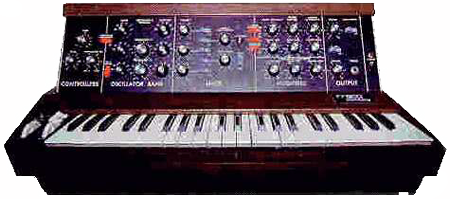
A more portable version was created and the "Mini-moog" was played by a number of musicians, most notably by Jan Hammer in the Mahavishnu Orchestra beginning in 1971. The Mini Moog proved versatile enough to allow Hammer to solo with equal musicality/facility to that of his colleagues John McLaughlin on guitar and Jerry Goodman on violin . Avant garde jazz musician Sun Ra often used the Moog as his instrument of choice to achieve his unique sound. A custom Moog Modular System was also featured prominently on Emerson, Lake & Palmer's song "Lucky Man," Keith Emerson's Moog solo at the end making it arguably the group's most popular piece. Another famous use of the Moog was in Tangerine Dream's electronic landmark album Phaedra in 1974, which was a major hit in the UK -- it reached #15 on the British album charts and playing a significant role in establishing the fledgling independent label Virgin Records.
In the late 70's and early 80's, Tejano music groups such as Mazz began using moogs which would later be used as part of what is called modern tejano.Later Moog modular systems featured improvements to the electronics design, and in the early 1970s Moog introduced new models featuring scaled-down, simplified designs that made them much more stable and well suited to real-time musical performance.
Unlike the early modular systems, the Minimoog was specifically created as a self-contained musical instrument designed for use in live performance by keyboard players. Although its sonic capabilities were drastically reduced from the large modular systems, the Minimoog combined a user-friendly physical design, pitch stability, portability and the ability to create wide range of sounds and effects.
Another brilliant Minimoog innovation was its famous wheel controllers. Moog designed a simple circuit, controlled by an easy-to-use spring-loaded wheel mounted vertically into the keyboard, just to the left of the lowest key. The wheels could be assigned to control functions such as the pitch of the oscillators, allowing Minimoog users to create the same expressive effects that guitarists can achieve by physically 'bending' a guitar string.
The Minimoog was the first product to really solidify the synthesizer's popular image as a "keyboard" instrument and it became the most popular monophonic synthesizer of the 1970s, selling approximately 13,000 units between 1971 and 1982, and it was quickly taken up by leading rock and electronic music groups such as the Mahavishnu Orchestra, Yes, Emerson, Lake & Palmer, Tangerine Dream and Gary Numan.
Although the Moog's popularity faded in the 1980s with the advent of digital synthesizers and sampling keyboards, the Minimoog remained a sought-after instrument for producers and recordings artists, and it continued to be used extensively on electronic, techno, dance and disco recordings into the 1980s due to the distinctive tonal qualities of its oscillators.
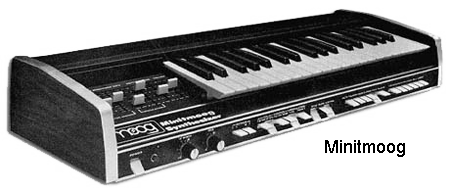 The rarest production model was the little Minitmoog (1975-1976). It is rumored that only a few hundred were ever made, although firm numbers are unavailable. While it lacked programmability and memory storage, it did offer some forward features, such as keyboard after touch and a sync-sweep feature, thanks to its dual voltage controlled oscillators.
A widely used and extremely popular Moog synthesizer was the Taurus bass pedal synthesizer. Released in 1975, its pedals were similar in design to organ pedals and triggered synthetic bass sounds. The Taurus was known for a "fat" bass sound and was used by the bands Genesis, Rush, Electric Light Orchestra, Yes, Pink Floyd, Parliament-Funkadelic, and many others. Production of the original was discontinued in 1981, when it was replaced by the Taurus II.
Moog Music was the first company to commercially release a keytar, the Moog Liberation. A keytar is a relatively lightweight keyboard or synthesizer that is supported by a strap around the neck and shoulders, similar to the way a guitar is supported by a guitar strap. Keytars allow players a greater range of movement compared to conventional keyboards, which are placed on stands. The instrument has a musical keyboard for triggering musical notes and sounds. Controls for pitch bends, vibrato, portamento, and sustain are placed on the instrument’s “neck".
The last Moog synthesizers were manufactured in 1985 before the original Moog Music declared bankruptcy in 1986. By the mid-1990s, analog synthesizers were again highly sought after and prized for their classic sound. In 2001, Robert Moog's company Big Briar was able to acquire the rights to the Moog name and officially became Moog Music. Moog Music has been producing the Minimoog Voyager modeled after the original Minimoog since 2002. As of 2006, more than 15 companies are making Moog-style synthesizer modules.
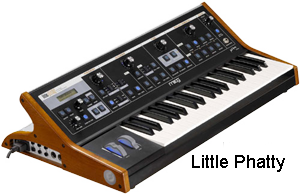
In March 2006, Moog Music unveiled the Little Phatty Analog Synthesizer, boasting "hand-built quality and that unmatched Moog sound, at a price every musician can afford". The first limited edition run of 1200 were a Bob Moog Tribute Edition with a Performer edition announced subsequently.
Today a number of Moog products can still be purchased, such as Moogerfoogers and Minimoogs. The Minimoog is so popular, in fact, that they regularly sell for over US$3000 on online auction sites like eBay.
Legendary Suggestions? Send them Here
Aces and Eighths. A music resource site. Link To Us
Site Map  Comments or Questions
  Submissions
Privacy Policy
| Share |
               |

AcesandEighths.com - All Respective Copyrights © Apply
All text is available under the terms of the GNU Free Documentation License. (See Copyrights for details.)
Also under the Creative Commons Org License. http://en.wikipedia.org/wiki/Moog_Synthesizer