


Guitars - Acoustic - Electric - Custom | Keyboards - Acoustic - Digital | Drums | Cymbals | Recording / Studio | Microphones | Amplifiers | Affiliates
Legendary Instruments
Hammond B3 - Stratocaster - Telecaster - Les Paul - Wurlitzer - White Falcon - Leslie - Moog


Leslie Speakers
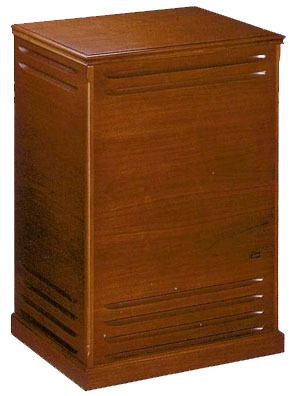
The Leslie speaker is a specially constructed amplifier/loudspeaker used to create special audio effects using the Doppler effect. Named after its inventor, Donald Leslie, it is particularly associated with the Hammond organ. The Hammond/Leslie combination is now a ubiquitous element in many genres of music. Currently both the Leslie Speakers and the Hammond Organ are owned by Suzuki Musical Instruments.
Although Hammond designed its own set of speakers, many players prefer to play the Hammond through a rotating speaker cabinet which, after several name changes, became known as the Leslie speaker, after its inventor Donald J. Leslie (1913–2004). The Leslie system is an integrated speaker/amplifier combination in which sound is emitted by a rotating horn over a stationary treble driver and a rotating baffle beneath a stationary bass woofer. This creates a characteristic sound due to the constantly changing pitch shifts that result from the Doppler effect created by the moving sound sources. It was originally designed to mimic the complex tones and constantly shifting sources of sound emanating from a large group of ranks in a pipe organ. The effect varies depending on the speed of the rotors, which can be toggled between fast (tremolo) and slow (chorale) using a console or pedal switch, with the most distinctive effect occurring as the speaker starts or stops rotating. During the 1970's, the Chicago, Illinois audio team of David J. Walat, P.E., and Paul Di Matteo, a musician by trade, were well known within the music industry for the modifications they made to Leslie cabinets. Their replacing the original transducers with an 18 inch woofer and dual high frequency drivers proved popular for high power stage applications. Examples of their work toured the world with bands such as Uriah Heep, Kansas and Procol Harum.
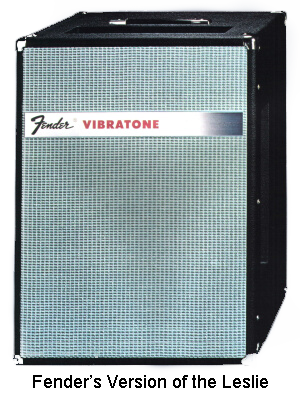
Don Leslie, at the outset, was refused hire by the Hammond Organ Company, but did work for the local electric company, in a contract with Hammond, to replace the old fifty cycle rotor tone generators with the new sixty cycle units, in customers' homes. The speaker's first name, in 1941, was the "Vibratone." (The name was used later by Fender Guitar Company for a speaker system and effects unit containing a Leslie rotating speaker. Fender also used the name "Leslie" after Leslie sold his company, in 1965, to CBS, which had also acquired Fender.) From 1941, when the first units were produced, the speaker went by several names including "Brittain Speakers", "Hollywood Speakers" and "Crawford Speakers", before returning to the name "Leslie Vibratone" in 1946. Seventeen years after it had rejected him, Leslie offered to sell the company to Hammond. After thirty days he had heard no word from Hammond. Don Leslie said: "After seventeen years, the thirty day period is up. Too late".
In 1980, the Hammond Corporation finally bought Electro Music and the Leslie name from CBS. To this day it remains part of Hammond under Hammond Suzuki, USA .
 Leslie never advertised his speakers. After demonstrating a prototype (a rotating baffle in a hole in a small closet with a big speaker in the closet near Leslie's home organ) with Bob Mitchell, an organist with radio station KFI near Los Angeles, a contract was made to install another prototype in the station's studios, where Mitchell would be the only organist authorized to use it. Mitchell was so impressed that he even tried to patent the speaker, but discovered that he couldn't. Soon afterwards, Mitchell became an organist with the Mutual Broadcasting System, and played a Hammond with the Leslie on its shows. The national exposure was swift and sure. Organists, professional and amateur alike, wanted to have "that sound". Jazz organist Jimmy Smith helped to popularize "that sound" among rock-n-roll musicians in the late 50's and early 60's. The Leslie of that time was over sixty inches tall (about the size of a modern refrigerator), and was named the 30A. Don Leslie made a whole series based on the 30A, called "Tall Boys" (31 series). In the 1950s, Leslie introduced the 21H for use in homes, concert hall venues and smaller radio sound stages.
Today, Leslie parts are available from a number of sources. There are also websites with plans (and photographic examples) for constructing a Leslie speaker, with much improved electronics and speakers. On the web, one can see a 500 W high performance Leslie.
The classic Leslie is still made and sold to this day, though similar effects can now be obtained via analogue electronic devices and digital emulation. Chorus and phase shifter devices can mimic the sounds produced by a Leslie speaker; in fact, early phase shifters like the Uni-Vibe were specifically marketed as low-cost Leslie substitutes for guitarists, and used a foot-operated fast/slow switch. Many agree that nothing can reproduce the sound of a Leslie speaker heard in person, but some digital emulations of the Leslie Doppler effect have become virtually indistinguishable from the sound of a recorded Leslie speaker.
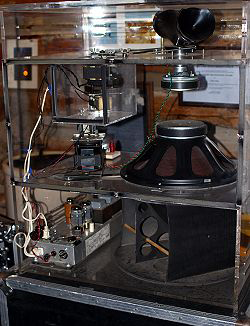
Although there have been many variations over the years, the classic Leslie speaker consists of two driver units - a treble unit with horns, and a bass unit. The key feature is that the horns of the treble unit (actually only one working horn, but a dummy horn is used to counter-balance it) and a sound baffle for the bass unit are rotated using electric motors to create 'Doppler effect based' vibrato, tremolo and chorus effects. The rotating elements can be switched between two speeds (or stopped completely by means of optional "brakes"), and the transition between the two speeds produces the most characteristic effects.
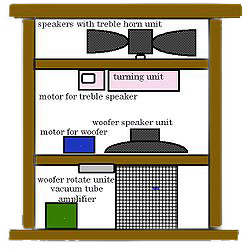 The resulting sound is instantly identifiable as that of the Hammond organ, frequently heard on psychedelic and rock music of the 1960s and 1970s. Unlike a high fidelity loudspeaker, the Leslie is specifically designed, via reproduction of the Doppler effect, to alter or modify sound; faithful reproduction has never been part of its appeal. Much of the unique tone is owed to the fact that the system is at least partially enclosed, but with linear louvres along the sides and front so that the unit can vent the sound from within the box after the sound has bounced around inside, mellowing it. While many organists prefer the fast "vibrato" setting, the Leslie's slow speed produces a lush "chorus" effect which suggests the sound of a pipe organ in a large hall or church much more effectively than static speakers can. The Leslie might be considered an electro-mechanical sonic effects machine. Many rock and roll organists have turned the box around to expose the horn's rotation for a visual effect, and in the hope of projecting a more powerful sound from both speakers. One can see such a reversed placement in The Band's movie, The Last Waltz, the film Woodstock, and Phish's DVD, It.
While normally used with an organ, Leslie speakers can be used with other instruments, allowing for a wide range of surprising and dramatic effects. However, this method usually requires a preamplifier/power unit accessory, since most Leslie models by themselves are incompatible with microphones or outside instruments, being interfaced with an organ via a multipin cable connector which also carries AC power.
As innovated by Beatles engineer Geoff Emerick, John Lennon's voice was processed through a Leslie speaker for the highly experimental song "Tomorrow Never Knows" on The Beatles' 1966 album Revolver. The Beatles also used George Harrison's Leslie-processed vocals on the song "Blue Jay Way" on their 1967 album Magical Mystery Tour.
Leslie models
The Model 122 is the classic two speed 40 Watt tone cabinet most commonly used with Hammond console organs, such as the B3, C3 and A100 models. Some organists connect two or more of these to their organ for a louder and more widely-spaced "surround" effect. A modern reproduction is the model 122A. This is the Leslie of choice for recording studios or other sonically demanding applications due to the quiet operation of the Model 122's differential signal input design. Leslie Model 142 is identical to Model 122, except that it is housed in a 33" tall cabinet, and thus slightly easier to transport than the 41" tall Model 122.
 The Model 147 has the same cabinet, speaker and mechanical components as the Model 122; however, the amplifier input and motor speed control circuits are different. This is primarily because this series was designed to be "universal", which means it could be connected to other organ brands. The signal input is "single-ended", allowing a simpler connection to organs that have a built-in speaker system, as the Hammond A100 or a Wurlitzer. The Model 122 input is a differential, "double-ended" or "balanced line" design that provides for cancellation of any spurious noise that may be present. Also, the motor speed switching uses a separate 120V AC signal, rather than the DC voltage control of the Model 122. In operation, the noticeable differences between the Model 122 and the Model 147 are the Model 122's lower susceptibility to induced noise, and a delay between operation of the speed control and the actual change in speed. Just like with the 122 and 142, the Leslie Model 145 is identical to Model 147, except that it is housed in a 33" tall cabinet, and thus slightly easier to transport than the 41" tall Model 147.
The Model 125 was the first model to have two speeds, and was introduced in 1963. Leslie produced two editions of each model, one for Hammonds (H) and one for Wurlitzer (W). Many organists still use combinations of these editions. The Model 125 has only a single rotor and 12" full-range speaker!
The smallest Leslie is the Leslie Model 16, made in 1970. It has a Fender-like speaker body and a rotating foam dispersion block. It was built for rough club touring, was portable, and had "Leslie" written on the front. It was also released later as Fender/CBS's "Vibratone". Stevie Ray Vaughan used this model on the song "Cold Shot" from the album Couldn't Stand The Weather. It can also be heard on Cream's "Badge" and Jimi Hendrix' "Little Wing". With supplies decreasing, its availability is becoming limited.
One of the favourite models for gigging Hammond X5 owners, the Model 760 with 90 watts of power is still a popular choice for organs with 9-pin connectors, despite being a "solid-state" model.
A smaller, more portable version of the 760 is the Model 825. It is a solid-state cabinet like the 760, and it connects to the organ with a 9-pin connector as well. However, it only has a 70-watt amplifier and only has a single rotor with a full-range 12" speaker.
An earlier model, the Model 25 is essentially a single speed 125. Like its successor, the 125 has one 12" speaker pointed into a single wooden baffle. These leslies are relatively inexpensive, and in recent years have been made popular with guitarists wanting to achieve effects similar to that of Pink Floyd.
Legendary Suggestions? Send them Here
Aces and Eighths. A music resource site. Link To Us
Site Map  Comments or Questions
  Submissions
Privacy Policy
| Share |
               |

AcesandEighths.com - All Respective Copyrights © Apply
All text is available under the terms of the GNU Free Documentation License. (See Copyrights for details.)
Also under the Creative Commons Org License. http://en.wikipedia.org/wiki/Leslie_speaker