


Guitars - Acoustic - Electric - Custom | Keyboards - Acoustic - Digital | Drums | Cymbals | Recording / Studio | Microphones | Amplifiers | Affiliates
Legendary Instruments
Hammond B3 - Flying V - Les Paul - Leslie - Moog - Stratocaster - Telecaster - White Falcon - Wurlitzer


Fender Telecaster
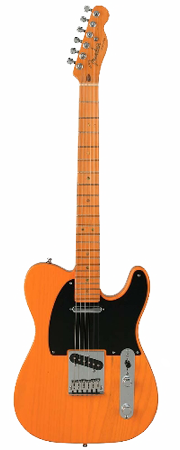 The Telecaster, commonly known as the Tele, is a dual-pickup, solid-body electric guitar made by Fender. Its simple yet effective design and revolutionary sound broke ground and set trends in electric guitar manufacturing and popular music. Introduced for national distribution as the Broadcaster in the autumn of 1949, it was the first guitar of its kind to be produced on a substantial scale. Its commercial production can be traced as far back as the March of 1950, when the single- and dual-pickup Esquire models were first sold. The Telecaster has been in continuous production in one form or another since its first incarnation, making it the world's oldest solid-body electric guitar.
The Fender Telecaster was developed by Leo Fender in Fullerton, California in 1949. Prior to its creation, the solid-body electric guitar had been created independently by several craftsman and companies, in the period roughly between 1932–1949, but none of these guitars had made a significant impact on the market. Leo Fender's Telecaster was the design that finally put the solid-body guitar on the map.
Leo had an electronics repair shop called Fender's Radio Service where he first repaired, then designed, amplifiers and electromagnetic pickups for musicians -- chiefly players of electric semi-acoustic guitars, electric Hawaiian (lap steel) guitars, and mandolins. Players had been 'wiring up' their instruments in search of greater volume and projection since the late 1920s, and electric semi-acoustics (such as the Gibson ES-150) had long been widely available. Tone had never, until then, been the primary reason for a guitarist to go electric, but in 1943, when Fender and his partner, Doc Kauffman, built a crude wooden guitar as a pickup test rig, local country players started asking to borrow it for gigs because it' s tone sounded shiny and sustained. Fender got curious, and in 1949, when it was long-understood that solid construction offered great advantages in electric instruments, but before any commercial solid body guitars had caught on, he built a better prototype. The hand-built prototype had most of the features of what would become the Telecaster.
The initial production model appeared in 1950, and was called the Esquire. Fewer than fifty guitars were originally produced under that name, and most were replaced under warranty because of early manufacturing problems. In particular, the Esquire necks had no truss rod and many were replaced due to bent necks. Later in 1950, this single-pickup model was discontinued, and a two-pickup model was renamed the Broadcaster. From this point onwards all Fender necks incorporated truss rods. The Gretsch company, itself a manufacturer of hollow body electric guitars, claimed that "Broadcaster" violated the trademark for its Broadkaster line of drums, so Fender changed the name to Telecaster.
Leo Fender's simple and modular design was geared to mass production, and made servicing broken guitars easier. Guitars were not constructed individually, as in traditional luthiery. Rather, components were produced quickly and inexpensively in quantity and assembled into a guitar on an assembly line. The bodies were band-sawed and routed from slabs, rather than hand-carved individually, as with other guitars made at the time, such as Gibsons. Fender did not use the traditional glued-in neck, but rather a bolt-on. This not only made production easier, but allowed the neck to be quickly removed and serviced, or replaced entirely. In addition, the classic Telecaster neck was fashioned from a single piece of maple without a separate fingerboard, and the frets were pressed directly into the maple surface--a highly unorthodox approach in its day (guitars traditionally featured rosewood or ebony fingerboards glued onto mahogany necks). The electronics were easily accessed for repair or replacement through a removable control plate, a great advantage over typical construction, in which the electronics could only be accessed through the sound holes in the case of hollow-body instruments, or later by taking off the pick guard after removing the strings (as in Fender's own later design, the Stratocaster).
In its classic form, the guitar is simply constructed, with the neck and fingerboard comprising a single piece of maple, bolted to an ash or alder body inexpensively jigged with flat surfaces on the front and back. The hardware includes two single coil pickups controlled by a three-way selector switch, and one each of volume and tone controls. The pick guard was first Bakelite, soon thereafter it was Celluloid (later plastic), screwed directly onto the body with five (later eight) screws. The bridge has three adjustable saddles, with strings doubled up on each. The guitar quickly gained a following, and soon other, more established guitar companies (such as Gibson, whose Les Paul model was introduced in 1952; and later Gretsch, Rickenbacker, and others) began working on wooden solid-body production models of their own. A large chromed cover, often called the "ashtray", was fitted over the bridge for improved grounding, but this is rarely seen as most players find it impedes their style.
The original switch configuration used from 1950 to 1952 allowed selection of neck pickup with treble tone cut in the first position (for a bassier sound), and neck pickup with normal tone in the second position. The third switch position selected the bridge pickup with neck pickup blended in, depending on the position of the second "tone" knob. The first knob functioned normally as a master volume control. This configuration did not have a true tone control knob.
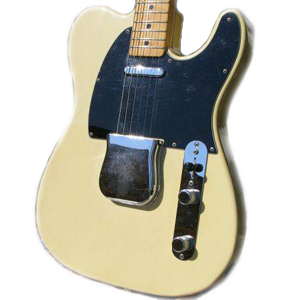
Typical modern Telecasters (such as the American Standard version) incorporate several details different from the classic form. They typically feature 22 frets (rather than 21) and truss rod adjustment is made at the head stock end, rather than the body end, which had required removal of the neck on the original . The 3-saddle bridge of the original has been replaced with a 6-saddle version, allowing independent length and height adjustment for each string. The long saddle bridge screws allows a wide range of saddle bridge positions for intonation tuning. The stamped metal bridge plate has been replaced with a plain, flat plate, and the bridge grounding cover has been discontinued for most models. Also different from the original is the wiring: The 3-way toggle switch selects neck pickup only in the first position, neck and bridge pickups together in the second position, and bridge pickup only in the third position. The first knob adjusts the master volume; the second is a master tone control affecting all the pickups.
The Telecaster is known for its bright, and rich cutting tone. One of the secrets to the Telecaster's sound centers on the bridge pickup, which has more windings than the neck pickup and hence has a much higher output, sometimes having twice the inductance of the neck pickup. At the same time, a capacitor is fitted between the slider of the volume control and the output, allowing treble sounds to bleed through while the mid and lower ranges are damped. A slanting bridge pickup enhances the guitar's treble tone. The solid body allows the guitar to deliver a clean amplified version of the strings' tone. This was an improvement on previous electric guitar designs, whose hollow bodies made them prone to unwanted feedback. These design elements allowed musicians to emulate steel guitar sounds, making it particularly useful in country music.
Variations and Models
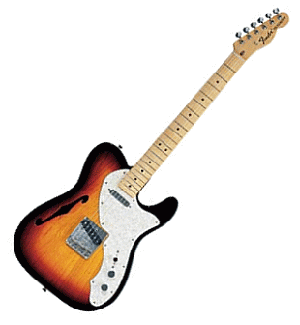
A semi-hollow Thinline version appeared in 1968/69, designed by German guitar maker Roger Rossmeisl. Today two versions of the Thinline are available, the '69 version has two standard Telecaster pickups and a mahogany body, while the '72 version, based on the Fender Telecaster Deluxe, yields two Fender Wide Range pickups and a solid natural swamp ash body
The Deluxe model includes two Fender Wide Range humbucking pickups and was originally produced from 1972 to 1981 and have since then been reissued. The Tele Deluxe sported a large headstock similar to the Stratocaster maple neck and a contoured body, as well as a tremolo bridge option on models manufactured after 1973/74.
The Tele Custom was popularized by Rolling Stones' guitarist and composer Keith Richards since its introduction in the early 1970's, featuring a Fender Wide Range humbucker in the neck position and a single-coil pickup in the bridge. The market generally refers to the guitar as the "1972 Custom", indicating the year this model was originally released.
Telecaster Plus was designed to restore Fender's reputation after a group of employees led by William C. Schultz took over ownership from CBS in the early 1980s. The pickups used in early models were dual humbucking Red Lace Sensors in the bridge position and a single Blue Lace Sensor in the neck position. Later models (post 1994 or so) used three Gold Lace Sensors or a Red/Silver/Blue set in a Strat-like configuration, as well as low-friction roller nuts, locking synchronized vibrato bridge and tuners and a bound contoured alder body with ash veneers. These instruments were discontinued in 1998 with the advent of the American Deluxe series; there have been no reissues.
The Fender Tele Jr. is a variant of the Fender Telecaster electric guitar, produced in a limited run of 150 units by the Fender Custom Shop in the early 1990s. While its body shape and scale length are those of the Telecaster, many of its construction and electronic features, for example its set-in neck are more similar to those of a Gibson Les Paul electric guitar.
The top-of-the-line American Deluxe Telecaster (introduced in 1998 and upgraded in 2004) features a pair of Samarium Cobalt Noiseless pickups and the S-1 switching system. Models made prior to 2004 featured two Fender Vintage Noiseless Tele single-coils and 4-bolt neck fixing. Other refinements include a bound contoured alder or ash body and an abalone dot-inlaid maple neck with rosewood or maple fingerboard, 22 medium-jumbo frets, rolled fingerboard edges, and highly detailed nut and fret work. The American Deluxe Telecaster HH sports an ebony fingerboard, quilted or flamed maple top and a pair of Enforcer humbuckers with S-1 switching. A Fishman Powerbridge was briefly offered on the American Deluxe Telecasters made from 2000 to 2001. Fender currently offers the Fishman bridge on the Mexican-made Deluxe Series Nashville Tele guitar.
The American Series model uses two single-coil pickups with DeltaTone system (featuring a high output bridge pickup and a reverse-wound neck pickup). Other features include a parchment pick guard, non-veneered alder or ash bodies and rolled fingerboard edges. There were also HS and HH guitars with Enforcer humbucking pickups and S-1 switching which debuted in 2003; they have been discontinued in 2007. As of 2008, all American Standard Telecasters came with a redesigned Tele bridge with vintage-style bent steel saddles.
The American Nashville B-Bender guitar is modeled after the personally customized instruments of some of Nashville's top players, featuring a Fender/Parsons/Green B-Bender system, two American Tele single-coils (neck, bridge), a Texas Special Strat single-coil (middle) and five-way "Strat-O-Tele" pickup switching. Ideal for country bends and steel guitar glisses, this Tele is available only with a maple fingerboard.
The American Series Ash Telecaster is based on the '52 vintage reissue. It features an ash body, one-piece maple neck/fingerboard with 22 frets and two Modern Vintage Tele single-coil pickups.
The Custom Classic Telecaster is the Custom Shop version of the American Tele guitar, featuring a pair of Classic and Twisted single-coils in the bridge and neck positions, as well as a reverse control plate. Earlier versions made before 2003 featured an American Tele single-coil paired with two Texas Special Strat pickups and 5-way switching.
The Highway One Telecaster (introduced in 2003) features a pair of distortion-friendly Alnico III single-coils, super-sized frets, Greasebucket circuit and '70s styling (since 2006). The Texas Telecaster sports a 1-piece maple neck/fret board with a modern 12” radius and 21 jumbo frets, solid ash body and a pair of Hot Vintage pickups.
The moderately-priced Standard, Classic and Deluxe Tele guitars are made in Mexico, Japan and Korea. Each of these instruments has a feature set which makes them an affordable value for any budget.
Artist Series Telecasters have features favored by world-famous Fender endorsees James Burton, John 5, Muddy Waters, Jim Root, G. E. Smith, Joe Strummer and Jim Adkins. Custom Artist models are made at the Fender Custom Shop, differing slightly quality and construction-wise; their prices are much higher than the standard production versions.
The Telecaster was important in the evolution of country, electric blues, funk, rock and roll and other forms of popular music, because its solid construction allowed the guitar to be played loudly as a lead instrument, with long sustain if desired, and with less of the whistling 'hard' feedback that hollow bodied instruments tend to produce at volume. Even though the Telecaster is more than half a century old, and more sophisticated designs have been coming out since the early 1950s (including Fender's own Stratocaster), the Telecaster has remained in constant production. There have been numerous variations and modifications, but a model with something close to the original features has always been available.
Legendary Suggestions? Send them Here
Aces and Eighths. A music resource site. Link To Us
Site Map  Comments or Questions
  Submissions
Privacy Policy
| Share |
               |

AcesandEighths.com - All Respective Copyrights © Apply
All text is available under the terms of the GNU Free Documentation License. (See Copyrights for details.)
Also under the Creative Commons Org License. http://en.wikipedia.org/wiki/Fender_Telecaster